


HI+Share price performance of the week 20/05/2021 - 26/05/2021
Changes compared to the previous week in %.
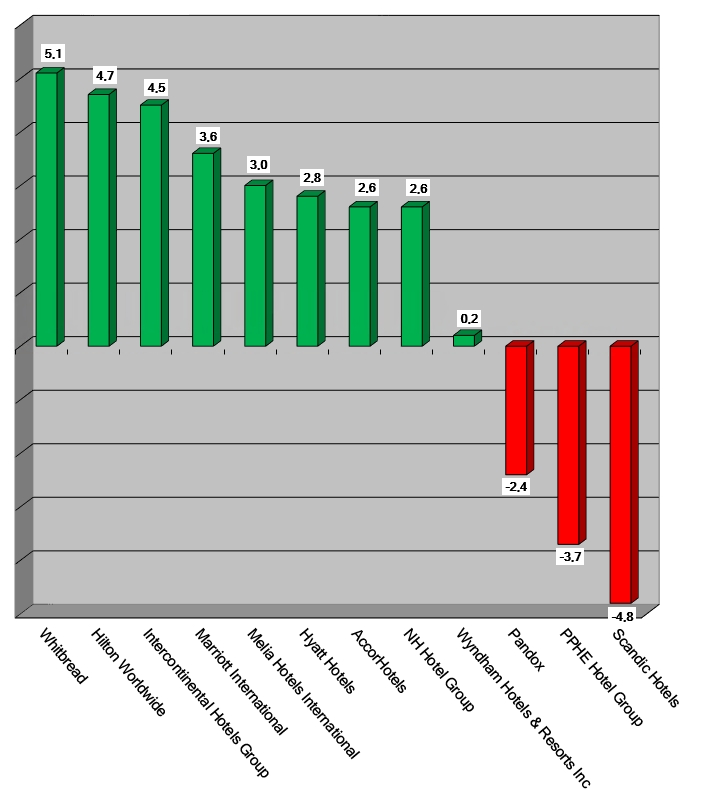
Source: Reuters
powered by HVS EMEA Enews

Vienna. With its latest equity crowdfunding, Falkensteiner Hotels & Residences has set a new record for investments among medium-sized enterprises. Within one month only, the hotel group collected 2.5 million euros from investors. The interest rate is four percent. The funding was oversubscribed by about one million euros, investors offered more than 7,000 euros to Falkensteiner on average.
Munich. Open-ended real estate funds are currently swimming in money - much as though the financial crisis had never happened. Yet this isn’t really deja-vu. Since the prices for offices, shopping centres and residential properties have risen ever more sharply, fund managers have discovered a new favourite asset class: hotels. Is the new love of hotels by open-ended real estate funds a flash in the pan? Beatrix Boutonnet from hospitalityInside.com says not.
Munich. They have probably closed the biggest European hotel real estate deal of the year: In late summer 2017, Invesco Real Estate acquired the EUR 530 million heavy portfolio from the US American private equity investor Apollo Global Management. Robert Stolfo, Invesco Real Estate Managing Director - Client Portfolio Management Europe, and Hans-Peter Hermann, Invesco Real Estate Director - Asset Management Hotels Europe, gave an interview to Beatrix Boutonnet on their first open-ended fund for institutional investors, the increasing time pressure facing their segment, the new investor caution as regards leverage and on the interesting question on how best to package assets.
Vienna. As of now, investors are able to invest in Falkensteiner Hotels & Residences via the financing platform Finnest. This way, the expansion into new markets will be supported, amongst others. Other hoteliers have already chosen this route to obtain financing.
Beijing. Irrational outbound investment in hotels, real estate, entertainment, and sports clubs are over for aggressive Chinese dealmakers whose acquisition strategy is now restricted by local authorities' new investment policies. HNA, Anbang, Fosun, etc. are now limited in their moves which raises concerns abroad regarding their due payments and further ongoing acquisitions. Will HNA be able to actually buy Rezidor's remaining shares as it is compelled to? Nothing is sure at this point. The company needs to make decisions and "big brother" is watching.
London/Munich. After the liquidation of its first two hotel funds, Invesco Real Estate now issues its third hotel fund, the "Invesco Real Estate European Hotel Fund". The investment portfolio with an investment volume of around EUR 200 million will consist of four hotels in Germany and the Netherlands.
Hamburg. Union Investment and bulwiengesa have calculated the market volume of investable hotels in Germany again. According to their calculations, the market value of investable hotels in Germany increased by 8.3% to EUR 51 billion between 2015 and 2016.
Vienna. The Deloitte OEHV "Tourismusbarometer" 2017 attests a cautiously yet optimistic mood among Austrian tourism companies with an index value of 2.99. They mainly complain about difficult financing and an increasing skilled labor shortage.
Paris. The "Booster project" has been causing a commotion at AccorHotels for months. Now, it stands shortly before completion: From 1 July 2017, AccorHotels and AccorInvest will act as completely separate companies, and until investors for AccorInvest are found, they will both operate as 100-percent subsidiaries of Accor SA. For this, the formal requirements have now been created.
Milan. In Italy, the hospitality industry is finally in the spotlight – thanks also to the decreasing profitability of more traditional real estate assets. Several influential and big asset management companies and hotel groups, new kids on the block as well as established players, recently gathered at a round table in Milan organized by the Master of Tourism Economy division of Bocconi University, in cooperation with Confindustria Alberghi and Horwath HTL. The discussion followed Horwath HTL's presentation of its "Hotels & Chains report" and focused on Italian hotel investment scenarios. The industry is learning: splitting assets and operations, initiating funds and watching properties to achieve profitability.